


India’s Semiconductor Mission 2025: Know How Much Investments Is Added In This Year
India depends on imports to fulfil its need of semiconductor devices. Major reason behind this highly dependent behaviour is the absence of semiconductor fabrication facility in India. While today, India has started its revolution in the international semiconductor market by establishing its existence and might be a valuable hub for semiconductor manufacturing in the years to come with vision India’s Semiconductor Mission 2025.
This blog will give an overview of the semiconductor development in India which is expected to rely on its increasing tech community, skilled professionals, and pro governmental policies along with the current ongoing global trend that challenges the sole manufacturing dominance of China and moving toward diversification of the semiconductor supply chain. The current situation and outlook will be discussed on how India is moving towards a major country to become a leading destination in the arena of semiconductor manufacturing.
Global supply chain diversification which supports for India’s Semiconductor Mission 2025
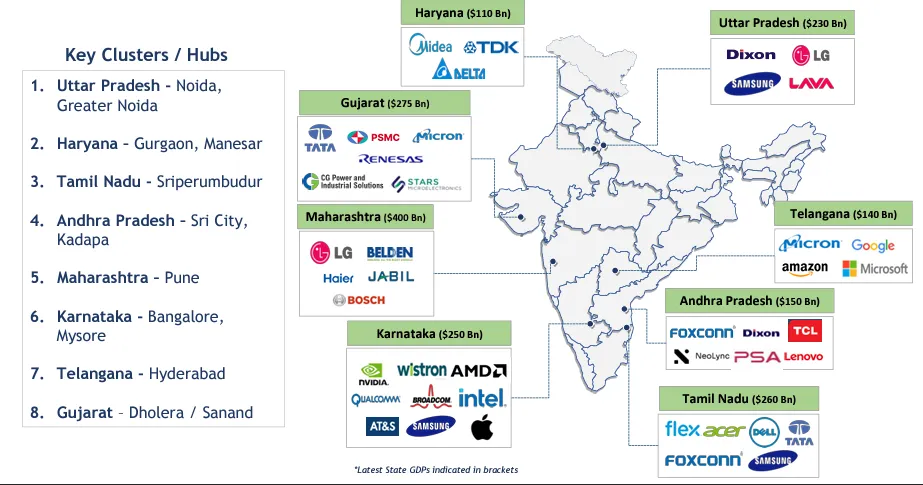
Traditionally concentrated in the US and its allies (South Korea, the Netherlands, Japan, and Taiwan), as well as China, the semiconductor value chain – including design, manufacturing and final product sales – has seen a shift due to pandemic-related disruptions and rising labour costs, prompting global producers to diversify away from China. India has become a preferred destination for back-end assembly and testing operations amidst this industry relocation, with potential for future front-end manufacturing.
India’s entry into this ecosystem is strategically significant for global supply chain diversification, given its stable political environment and vast domestic market, which are appealing factors for technology companies seeking greenfield expansion opportunities. India is pushing this sector with PLI Scheme to be independent in Electronic manufacturing sector. With MAKE IN INDIA initiative the Indian Government has launched India’s Semiconductor Mission 2025 is on the line to boost India’s economy in electronic manufacturing.
Top 10 companies invested in semiconductor sector in India for India’s Semiconductor Mission 2025
| Companies | Amount Invested( INR ) | Location in India |
| 1. Micron Tech | Rs 22,516 Cr | Sanand, Gujarat |
| 2. Tata and Powerchip | Rs 91000 Cr | Dholera, Gujarat |
| 3. Tata Electronics | Rs 27000 Cr | Morigoan, Assam |
| 4. CG Power, Renesas, Stars | Rs 7600 Cr | Sanand, Gujarat |
| 5. Kaynes Semicon | Rs 3300 Cr | Sanand, Gujarat |
| 6. HCL, Foxconn JV | Rs 3706 Cr | Jewar, Uttar Pradesh |
| 7. SiCSem | Rs 2066 Cr | Odisha |
| 8. HIPSCL | Rs 1943 Cr | Odisha |
| 9. ASIP | Rs 468 Cr | Andra Pradesh |
| 10. CDIL | Rs 117 Cr | Mohali, Punjab |
🚨 Semiconductor investments approved by India.
— Indian Tech & Infra (@IndianTechGuide) August 13, 2025
1. Micron Tech – Rs 22,516 crore – Sanand, Gujarat.
2. Tata & Powerchip – Rs 91,000 crore – Dholera, Gujarat.
3. Tata Electronics – Rs 27,000 crore – Morigaon, Assam.
4. CG Power, Renesas, Stars – Rs 7,600 crore – Sanand,…
Policy support for India’s Semiconductor Mission 2025
The Indian government has promptly seized the opportunity following the global semiconductor supply chain glut after the pandemic and showed great intent through policy support to present India as an alternative to China in the global semi supply chain supporting India’s Semiconductor Mission 2025. We discuss the government initiatives in detail in the section below.
Government initiatives for India Semiconductor Mission 2025
The India Semiconductor Mission (ISM) functions as a dedicated division within the Digital India Corporation. Its main goal is to nurture a strong semiconductor and display ecosystem to position India as a prominent global player in electronics manufacturing and design. Under the guidance of international experts in the semiconductor and display industry, ISM serves as a central authority for executing the Programme for Development of Semiconductor and Display Ecosystem, ensuring coordinated implementation, in collaboration with government ministries, industry and academia for mission India’s Semiconductor Mission 2025.
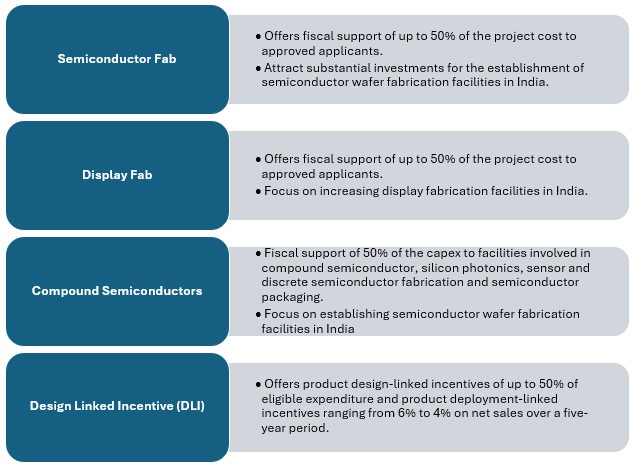
Under ISM, there are several schemes in place:
The Ministry of Electronics and Information Technology (MeiTY) has recently recognised Aheesa Digital Innovations and Calligo Technologies as newly designated start-ups eligible for assistance under the SemiconIndia futureDESIGN DLI Scheme.
Other MoUs signed by the government:
Based on the official sources, the Union Cabinet has given its go-ahead to the Memorandum of Understanding between India and the European Commission so that they could improve collaboration in relation to semiconductor ecosystems. This MoU forms part of the EU-India Trade and Technology Council, whose objective is to develop a more advanced semiconductor industry and better digital technology across both areas for further industrial growth.
Also, the cabinet has approved an MoC regarding the Japan-India Semiconductor Supply Chain to build a stronger partnership between the two nations. The aim of this MoC is to further mutual collaboration and make an unshakable semiconductor supply chain available.
The Semicon India Programme was initiated by the government in December 2021 with an initial allocation of Rs. 76,000 crore (US$ 9.2 billion) aimed at fuelling the growth of semiconductor and display manufacturing ecosystems in the country.
In the interim Union Budget for 2024, India has raised the allocation for the Semicon India Program to be equal to Rs. 6,903 crore (US$ 833.7 million). The most recent financial details available for the Modified Programme for Development of Semiconductors and Display Manufacturing Ecosystem in India during FY24 suggest a revised estimate of expenditure at US $181.5 million (Rs. 1,503 crore).
Under this programme, companies, consortia, or joint ventures can receive a fiscal incentive of 50% of the project cost for starting a semiconductor fab of any size (including mature nodes) within India. In addition, an equal fiscal incentive is available for those planning to establish display fabs in India with designated technologies. This measure confirms India’s determination to be the heart of global semiconductor manufacturing and reinforce its role in the digital economy.
Investments in semiconductor industry to support India’s Semiconductor Mission 2025
In the Indian semiconductor industry, large amounts of investments have been made to signify the growing importance of India in the global scenario. Not only have domestic but also international bodies established their production bases and research centres in different parts of India. For example, Tata Electronics has invested heavily in its Gujarat and Assam-based semiconductor manufacturing plants, on top of partnerships with the world’s top companies PSMC and Renesas Electronics Corporation. This describes the scale and objectives these endeavours set out with.
These are more than just investments; they are signals of faith in India’s capability as a global centre for semiconductor production and serve to underline India’s importance in the world supply chain. This would also put India at an advantage as it can attract more investments with constant support and generous policies.

PH363 seems like a solid place. Found some games I can really get into. Worth checking out if you’re looking for something fresh ph363.
Just played on LuckyPKR1000. Had a pretty fun time, actually! It’s got a nice setup. Definitely one to try if you’re feeling lucky luckypkr1000.
5hbetcom is alright, you know? Nothing too fancy, but it gets the job done. Kinda like that trusty old pair of sneakers. Check it out yourself 5hbetcom.